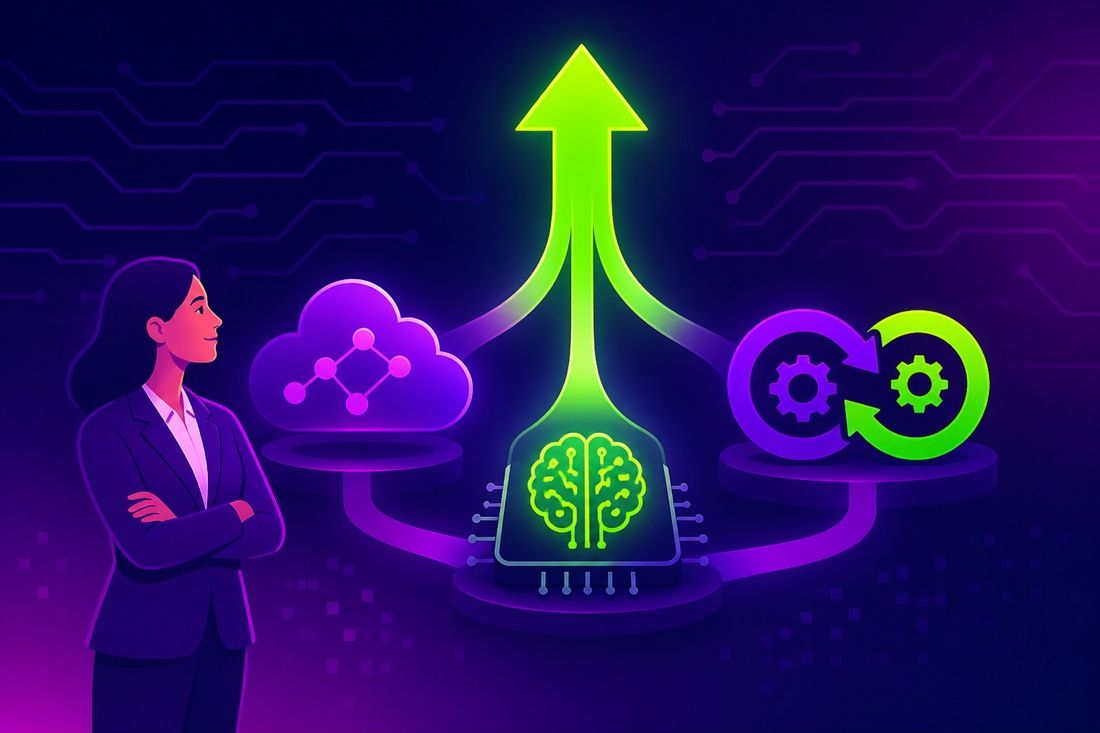
In the relentless drive for efficiency and innovation, the UK’s public and private sectors are saturated with talk of digital transformation. The promise is immense: a future of smarter services, faster delivery, and profound cost savings. Yet, for many leaders, this promise feels frustratingly distant, buried under the weight of legacy systems, stalled projects, and budgets that seem to evaporate with little to show for it. This report cuts through the hype to offer a pragmatic, evidence-based guide for senior leaders. It translates the often-opaque technologies of Cloud, AI, and DevOps into the board-level outcomes that truly matter: cost, speed, and resilience.
What you’ll learn:
- Why the government’s £45 billion modernisation ambition is stalled, and how to diagnose the “innovation debt” holding your own organisation back.
- Three concrete, evidence-backed patterns for success that are delivering measurable value today—from unlocking organisational knowledge with AI to cutting cloud costs by 40%.
- How to spot and navigate the three most common pitfalls that derail technology programmes, and a board-level framework for de-risking your next major investment.
The £45 Billion Question: Why Are We Still Stuck?
The UK government has laid out a bold roadmap, aiming to harness technology to deliver £45 billion in public sector savings. This ambitious figure is built on levers like automating delivery (£36 billion) and migrating services to cheaper digital channels (£4 billion). The potential for transformation is undeniable, with the Department for Science, Innovation and Technology (DSIT) and the Cabinet Office championing AI as a key to boosting productivity and improving services.
And yet, a dose of reality is required. The National Audit Office (NAO), in its typically sober fashion, has observed that government’s digital transformation attempts over the last decade have yielded “mixed success”. The Public Accounts Committee (PAC) goes further, stating bluntly that progress in tackling fundamental barriers has been “too slow”. This isn’t just a public sector problem. Across the enterprise landscape, 90% of IT leaders admit that their own legacy technology actively prevents innovation. Meanwhile, UK businesses are wasting an average of 35% of their cloud spend on inefficient or unused resources—a figure that saw one London-based FinTech startup leaking £7,000 every month.
The core of this paradox lies in a failure to confront what can be termed “innovation debt.” The PAC explicitly connects the inability to adopt modern tools like AI to “out-of-date legacy technology and poor data quality”. This is not a secret; government has identified its highest-risk legacy systems, yet as of early 2025, 21 of the 72 systems prioritised for remediation still lack the funding to be fixed. At the same time, significant operational expenditure is being wasted on poorly optimised cloud estates. This creates a vicious cycle: the money needed to fix the old systems (which would unlock new value) is being squandered on inefficient use of the new ones.
This isn’t just technical debt; it’s a strategic liability. The cost of not modernising is the inability to deploy the very technologies, like AI, that are meant to deliver the next wave of productivity. Leaders must therefore view the state of their legacy estate not as a background IT issue, but as a direct, quantifiable risk to their strategic goals—a debt on the innovation balance sheet that must be managed with the same rigour as financial liabilities. It seems our digital transformation strategies are often built on foundations of digital sand.
The Real Engine of Change: Cost, Speed, and Resilience
To build on solid ground, leaders must understand that Cloud, AI, and DevOps are not a menu of disconnected options to be chosen from. They are a single, interconnected engine for driving change. When integrated strategically, they create a virtuous cycle that delivers on the three outcomes that boards and permanent secretaries care about: cost efficiency, speed to market, and operational resilience.
First, let’s establish some plain-English definitions:
- Cloud: More than just “someone else’s computer,” it is on-demand access to elastic compute, storage, and services, paid for by consumption. Its primary strategic benefit is shifting capital expenditure to operational expenditure (CapEx to OpEx) while enabling unprecedented scale and resilience.
- DevOps: A cultural and operational model that uses automation to break down the traditional silos between software development (Dev) and IT operations (Ops). Its primary strategic benefit is the ability to deliver higher-quality services at a much greater speed.
- AI: The use of computer systems and models to perform tasks that normally require human intelligence, from recognising patterns and making predictions to generating new content. Its primary strategic benefit is unlocking productivity and generating novel insights from data.
These three are not independent workstreams to be managed in silos; they form a powerful, self-reinforcing flywheel. The process begins with DevOps practices, such as continuous integration and continuous delivery (CI/CD), which provide the how for rapid, reliable software development. These modern practices are made tangible and scalable through Infrastructure as Code (IaC), a technique that runs most effectively on Cloud platforms, directly linking the speed of DevOps to the elasticity of the Cloud.
This well-oiled Cloud and DevOps environment does two things: it frees up valuable engineering time from manual, repetitive tasks, and it generates a huge volume of operational data. This newly available capacity and data can then be used to train and deploy AI models. For example, AI for IT Operations (AIOps) can analyse system logs to predict failures before they happen or identify opportunities to optimise cloud spend automatically.
This closes the loop. The insights generated by AI are fed back into the DevOps cycle, making it smarter, faster, and more efficient. An AI might suggest an optimisation to an IaC template, or flag a security vulnerability in code before it’s deployed. Investing in one of these pillars directly accelerates the other two. A successful strategy must therefore be a triple-threat, encompassing all three. Trying to do AI without modern cloud and DevOps is like trying to win a Formula 1 race with a horse and cart.
| Technology | Primary Board-Level Outcome | Key Enabler | Primary Risk to Manage |
|---|---|---|---|
| Cloud | Resilience & Cost Flexibility | Elasticity, On-demand provisioning | Uncontrolled Spend (FinOps) |
| DevOps | Speed & Quality | Automation, CI/CD Pipelines | Cultural Resistance, Skills Gaps |
| AI | Productivity & Insight | Data, Algorithms | Data Quality, Ethics & Bias |
Pattern 1 (Productivity): The Knowledge Multiplier with RAG
A primary barrier to adopting AI is the risk of it producing inaccurate or irrelevant information—a phenomenon known as “hallucination.” For any organisation, particularly in the public sector, AI must be grounded in truth. This is where a pragmatic and powerful pattern called Retrieval-Augmented Generation (RAG) comes in.
In plain English: RAG is a technique that connects a general-purpose AI model to an organisation’s own private, authoritative data sources. Before generating an answer, the AI first “retrieves” relevant facts from a designated knowledge base (like internal policy documents, HR guides, or technical manuals). This ensures the final response is based on the organisation’s specific context and data, not just the generic information the AI was trained on. It’s like giving an expert an open-book exam using your own company’s library.
A landmark UK government trial provides a powerful, quantified story of RAG in action.
- Goal: To boost productivity and free up civil servants’ time for higher-value work.
- Action: Over a three-month period in late 2024, 20,000 civil servants were given access to Microsoft 365 Copilot, a tool that uses RAG to assist with tasks like drafting documents, summarising long email chains, and finding information within the government’s own systems.
- Result: The impact was immediate and significant. Participants saved an average of 26 minutes per person, per day, which equates to nearly two working weeks per year. Over 70% of users agreed the tool reduced time spent on mundane tasks, allowing them to focus on more strategic activities. Specific use cases emerged, such as Department for Work and Pensions (DWP) work coaches using the tool to more quickly personalise advice for jobseekers, and Companies House staff speeding up responses to routine customer queries.
This pattern matters because RAG offers a cost-effective and rapid path to deploying trustworthy AI. It avoids the immense expense and complexity of retraining a large language model (LLM) from scratch. Crucially, it builds user trust by enabling the AI to cite its sources, giving users a clear path to verify the information and dramatically reducing the risk of hallucinations. RAG stops your AI from making things up, which is generally considered a good career move for both man and machine.
At Devsultants, we’ve seen that getting RAG right depends entirely on the quality of the knowledge base you connect it to. This is where foundational work in data enrichment—cleaning, structuring, and enhancing your organisation’s information—becomes critical. Our delivery teams have direct experience preparing sensitive data for precisely these kinds of secure, high-impact AI applications.
Pattern 2 (Speed): The Speed Engine with Infrastructure as Code
For decades, a primary bottleneck in delivering new digital services has been the slow, manual, and error-prone process of setting up the required IT infrastructure. A request for a new server or database could take weeks, mired in tickets and manual configuration. This friction is the enemy of agility. The solution is a foundational DevOps practice: Infrastructure as Code (IaC).
In plain English: IaC is the practice of managing and provisioning IT infrastructure—servers, networks, load balancers, databases—through machine-readable definition files, rather than manual configuration. These files are treated like any other software code: they can be stored in a version control system, reviewed by peers, tested automatically, and deployed as part of an automated pipeline. This guarantees that you can create the exact same environment, consistently and reliably, every single time.
This pattern is not theoretical; it is being implemented to drive tangible results across sectors.
- Goal: To accelerate service delivery, improve consistency, and reduce the risk of human error.
- Action: Organisations adopt a declarative IaC tool (such as Terraform) to define their cloud infrastructure in code. This code is integrated into a CI/CD pipeline, which automatically tests and deploys any changes. This approach is mandated as a standard in forward-leaning government departments like the Home Office and is a core principle of the UK Government’s Technology Code of Practice.
- Result: The impact on speed is dramatic. Teams report reducing infrastructure provisioning time from “weeks to minutes”. According to industry reports, high-performing organisations that embrace these practices have reduced their software release cycle times by a factor of 2x or more. One manufacturing firm that moved to a software-defined infrastructure saw an 82% improvement in performance and a significant acceleration in the deployment of new services. Furthermore, IaC provides a powerful boost to resilience; in a disaster scenario, an entire production environment can be recreated from code in a different location, drastically reducing recovery times.
This pattern is critical because it directly attacks “configuration drift”—the slow, silent accumulation of undocumented manual tweaks that makes systems fragile, unpredictable, and difficult to manage. IaC enforces discipline and creates an immutable, auditable record of your infrastructure, which is a prerequisite for achieving the speed and resilience promised by the cloud. Infrastructure as Code is the difference between bespoke tailoring and an assembly line. Both can produce a suit, but only one can do it at scale, consistently, for a thousand people by Friday.
Implementing IaC securely, particularly within secure environments, requires a specific combination of deep cloud platform knowledge and security expertise. At Devsultants, our expertise in cloud strategy and our experience of secure delivery ensures that automation is built in a way that is compliant and secure by design, from day one.
Pattern 3 (Cost & Resilience): The Efficiency Dividend with Autoscaling
The cloud’s greatest strength—its elastic, pay-as-you-go nature—can quickly become a financial liability if not managed with discipline. Without proper controls, costs can spiral, eroding the business case for migration. One of the most effective patterns for imposing this discipline and reaping an efficiency dividend is autoscaling.
In plain English: Autoscaling is a cloud feature that automatically adjusts the amount of computing resource allocated to an application based on real-time demand. When traffic surges (e.g., during a major public announcement or a sales event), it seamlessly adds more capacity to maintain performance and prevent crashes. When demand is low (e.g., overnight or on a weekend), it automatically removes that capacity to save money.
The Home Office’s cloud cost optimisation programme provides a compelling UK public sector example.
- Goal: To significantly reduce a large and growing cloud bill without compromising the performance of critical immigration services.
- Action: The Immigration Technology department implemented a robust FinOps (Financial Operations) strategy. A key element was making autoscaling a standard, non-negotiable component of every new service build. For their flagship Access UK online visa application service, this allowed them to reduce the baseline number of running containers from a fixed 20 down to just 2, with the system automatically scaling up only when user demand increased.
- Result: The programme delivered a 40% reduction in their overall cloud costs. This was complemented by other simple but effective measures, such as scheduling non-production environments to automatically shut down during evenings and weekends, which saved over 60% on those specific workloads. These results are not unique; NHS England achieved similar savings of approximately 40% by establishing a Cloud Centre of Excellence with a strong FinOps function.
This pattern matters because it directly tackles the estimated 35% of cloud spend that UK businesses waste on overprovisioned or idle resources. It turns what is often treated as a fixed operational cost into a variable one that is directly proportional to business activity. This not only saves money but also enhances resilience by ensuring services can gracefully handle unexpected peaks in demand without manual intervention. Letting your cloud bill run without autoscaling is like leaving the heating on full blast in an empty office all weekend. It keeps the servers warm, but it’ll give your CFO a cold sweat.
Realising these kinds of savings requires more than just a technical fix. It demands a compelling business case to secure the necessary investment and a clear cloud strategy that embeds a culture of cost-consciousness. At Devsultants, we specialise in developing these HMT-compliant business cases and technology optimisation strategies that connect technical changes to tangible financial outcomes.
The Three Horsemen of Tech Project Failure
To build trust, we must be honest about why so many promising technology programmes fail. It is rarely the technology itself that is the problem. More often, failure stems from a handful of recurring strategic and foundational mistakes. By asking the uncomfortable questions upfront, leaders can steer their organisations away from these common traps.
Pitfall 1: The Lift-and-Shift Mirage
The first and perhaps most seductive trap is the “lift-and-shift” migration. This is the act of moving legacy applications to the cloud “as-is” without re-engineering them for the new environment. The allure is the perceived speed and simplicity.
The consequence, however, is that you get the worst of both worlds. You fail to unlock the true benefits of the cloud, like autoscaling, serverless computing, and enhanced resilience, because your application isn’t designed to use them. Instead, you end up running your old, inefficient, and often insecure systems in a more expensive location, inheriting all their existing problems while adding a hefty cloud bill and new, cloud-specific security risks. The UK’s National Cyber Security Centre (NCSC) is unambiguous on this point, warning that this approach “can introduce security issues” and “should be avoided where possible”.
The question for the board: “Are we truly modernising our services, or are we just running our old, expensive problems in a more expensive datacentre?”
Pitfall 2: The Data Quagmire
The second horseman is the temptation to launch an ambitious AI project without first getting your data house in order. AI models, particularly for enterprise use, are not magic; they are powerful engines that run on data. If the fuel is contaminated, the engine will sputter and fail.
The consequence of ignoring data quality is that your AI will produce inaccurate, biased, or simply useless results, undermining user trust and wasting investment. The Public Accounts Committee has identified this as a critical threat, stating that “poor data quality and data-sharing is putting AI adoption in the public sector at risk”. This is borne out by industry data: a 2024 report found that only 12% of organisations believe their data is of sufficient quality for effective AI implementation. Another survey found that 42% of UK companies cite data quality as their number one concern when starting AI projects.
The question for the board: “Have we honestly audited the quality, accessibility, and bias of the data our flagship AI project will depend on, and do we have a funded plan to fix it?”
Pitfall 3: The Escape from Pilot Purgatory
The final trap is “pilot purgatory”—the state of running endless, small-scale technology pilots that demonstrate promise in isolation but never scale to deliver meaningful, enterprise-wide value.
The consequence is a slow drain of resources, widespread “innovation theatre” that looks busy but achieves little, and a growing cynicism across the organisation. This is a well-documented problem in the UK public sector. A March 2024 NAO survey found that 70% of government bodies were still only piloting or planning AI use cases, with very few examples of successful, at-scale adoption. The PAC criticised the government’s lack of a “systematic mechanism for bringing together learning from pilots” to support scaling. The root causes are rarely technical; they are strategic. They include a failure to align pilots with clear business outcomes, designing them on infrastructure that cannot scale, and running them in isolated silos without a clear path to production.
The question for the board: “Does this pilot have a clear and credible path to production, with defined success metrics, a scalable architecture, and a plan for enterprise-wide integration from day one?”
These three pitfalls are not independent; they are a toxic, interconnected sequence. A “lift-and-shift” project (Pitfall 1) often moves the very legacy systems that are the source of the “data quagmire” (Pitfall 2). An AI pilot built on this shaky data foundation will inevitably struggle to prove its value, condemning it to become a permanent experiment stuck in “pilot purgatory” (Pitfall 3). Avoiding the first trap is therefore a prerequisite for solving the second, which in turn is the key to escaping the third.
::: Reality Check
The Public Accounts Committee states that out-of-date legacy technology and poor data quality are putting AI adoption in the public sector at risk. As of early 2025, 21 of the 72 highest-risk legacy systems in government still lack remediation funding. :::
A Framework for De-Risking Your Next Big Bet
Given the potential rewards and the significant risks, how can leaders make better investment decisions? The key is to move from reactive, technology-led choices to a proactive, strategic portfolio approach. This simple framework can help you assess and prioritise your initiatives, ensuring you place your bets on the projects most likely to succeed.
The Tech Value-Readiness Matrix is a 2x2 grid that plots initiatives against two critical axes, drawing on concepts from board-level governance checklists and technology readiness frameworks.
- The Vertical Axis: Potential Business Value (Low to High). This assesses the “why.” How much will this project move the needle on our core objectives of cost, speed, or resilience? Is it directly aligned with our organisation’s strategic goals?
- The Horizontal Axis: Organisational Readiness (Low to High). This assesses the “how.” Do we have the necessary foundations in place? This includes clean and accessible data, modern cloud infrastructure, the right in-house skills, and clear board-level accountability.
Plotting your current and proposed projects onto this matrix reveals four distinct strategic quadrants:
- Bottom-Left (Low Value, Low Readiness): Deprioritise. These are the science projects, the pet projects, and the distractions. They offer little strategic value and you lack the capability to deliver them well. The correct action here is to be ruthless: actively stop or pause this work to free up resources for more important initiatives.
- Top-Left (High Value, Low Readiness): Build Foundations. This is the most critical and often neglected quadrant. The potential prize is huge, but you are not yet ready to win it. The strategic focus here should not be on the shiny new technology itself, but on the unglamorous enabling work required to get ready. This is where you invest in data cleanup, legacy system remediation, cloud platform modernisation, and skills development.
- Bottom-Right (Low Value, High Readiness): Experiment & Automate. Here, you have strong capabilities, but the potential business impact is limited. This is the ideal quadrant for low-cost experiments, using automation to eliminate administrative toil, and keeping your teams’ skills sharp on new technologies without betting the farm.
- Top-Right (High Value, High Readiness): Invest & Scale. This is the green light. These are your strategic winners—initiatives that are both important and feasible. These projects should be funded properly, staffed with your best talent, and driven aggressively towards enterprise-wide adoption to realise their full value.
Plotting your projects on this grid helps separate the strategic game-changers from the magpie-like attraction to shiny new objects.
What to Do on Monday Morning
Analysis is useful, but action is what matters. Here are three concrete steps you can take next week to begin applying these principles and build momentum.
- Goal: Get an honest baseline of your “Innovation Debt.”
- Action: Commission a rapid, focused audit of your top 10 most critical legacy systems. For each, ask your teams to answer three questions: What is the annual cost to simply maintain this system? What specific strategic initiatives is it currently blocking? What is the high-level, estimated cost to modernise or replace it? This directly addresses the PAC’s call for greater transparency on the costs of legacy tech.
- Result: You will have a data-driven view of your biggest blockers, allowing you to have a strategic conversation about prioritising remediation based on the value it unlocks, not just the technical risk it mitigates.
- Goal: Find and reinvest your wasted cloud spend.
- Action: Task a joint team from finance and technology to conduct a 30-day cloud cost analysis. Give them a clear target to find 15-20% in savings by focusing on the most common sources of waste: idle non-production environments running 24/7, overprovisioned servers, and unoptimised storage.
- Result: You will identify quick wins that can immediately reduce operational expenditure. Earmark these savings to fund the foundational “readiness” work identified in step 1, creating a self-funding modernisation programme.
- Goal: De-risk your flagship AI pilot.
- Action: Take your most important AI initiative and plot it on the Value-Readiness Matrix from the previous section. Be brutally honest with your leadership team about the “Readiness” score. If it falls in the “Low Readiness” half of the grid, have the courage to pivot the project’s immediate focus. The goal is no longer to deploy the AI, but to “Build Foundations” by fixing the underlying data or infrastructure issues first.
- Result: You will dramatically increase the project’s long-term probability of success by ensuring it is built on solid ground, preventing the slow, demoralising slide into pilot purgatory.
Translating these goals into action requires a specific blend of technical expertise, commercial acumen, and a deep understanding of public and enterprise governance. The challenges of legacy debt, data quality, and cloud strategy are complex, but they are solvable.
If you’d like an independent, expert partner to help you conduct that baseline audit, build the business case for modernisation, or de-risk your next major programme, my colleagues and I at Devsultants are here to have that conversation. We specialise in the difficult discovery and de-risking work that turns ambition into reality.
Reach out for a no-obligation chat about where you are on the journey and how we can help you get to your destination, faster.
Want to talk this through?
We help organisations put ideas like these into practice. Tell us what you are working on and we will help you find a practical next step.