You’ve just received two quotes for your critical new digital service. One, from a UK-based specialist, comes in at £90 per hour. The other, from a highly-rated offshore team, is a tempting £25 per hour. The maths seems simple; the savings, undeniable. But what if the maths is wrong? What if that ‘cheap’ team is about to become the most expensive decision you make all year? For too long, public and private sector leaders have been seduced by the low headline rate, confusing price with value. This is a strategic error. The real measure of a development partner isn’t the day rate; it’s the Total Cost of Ownership (TCO)—a figure that reveals the hidden taxes of poor quality, coordination friction, and security risk that turn ‘savings’ into budget-breaking overruns.1 This isn’t just theory; it’s a financial evaluation method, popularised by Gartner, that assesses the complete cost of an asset over its entire lifecycle.3 In this report, you will learn:
- How to identify the hidden costs that inflate ‘low-cost’ development projects.
- A simple framework to decide when offshoring is genuinely viable (and when it’s a trap).
- How to use a Total Cost of Ownership (TCO) calculator to make a data-driven, value-based sourcing decision.
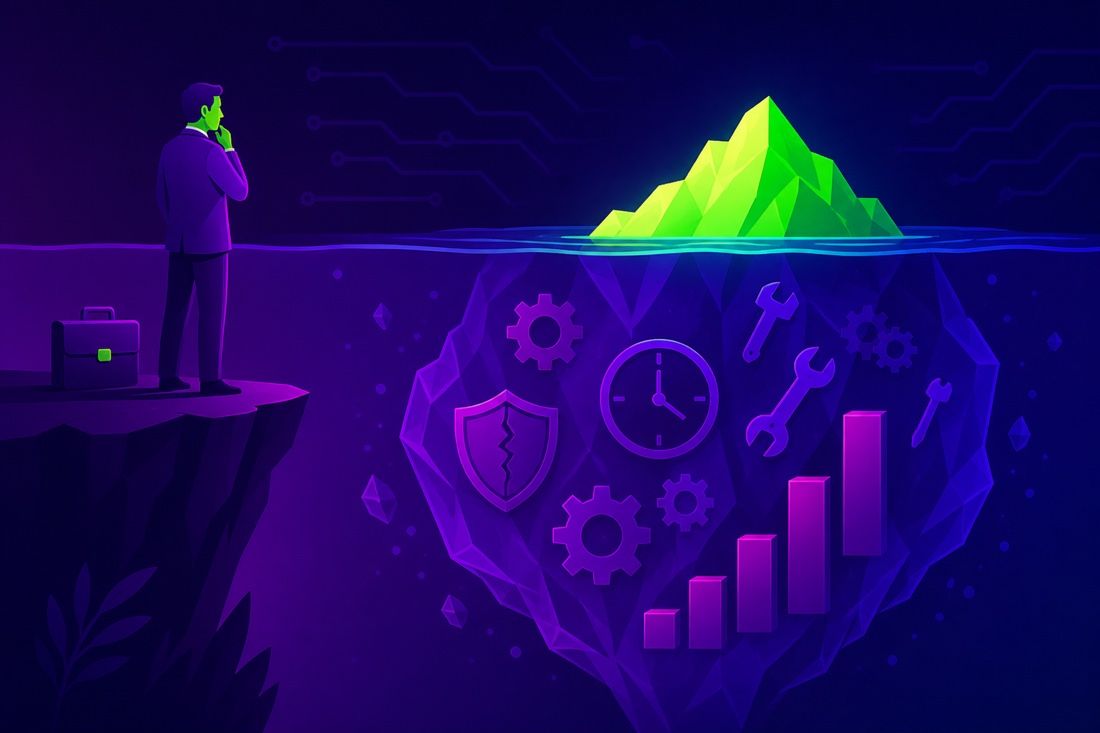
The Iceberg Below the Surface: Unmasking the Hidden Costs
Takeaway: The initial saving on developer rates is frequently dwarfed by unforeseen expenses in management, rework, and security. The Total Cost of Ownership for software isn’t just the initial build. In fact, studies suggest that the initial acquisition cost often represents only 20% of the TCO.6 The other 80% is the vast, submerged part of the iceberg: ongoing costs for maintenance, support, training, and, most critically, the cost of getting it wrong.7 These hidden costs aren’t random; they are a predictable consequence of procuring complex work based on the lowest price. They manifest in three main areas: the coordination tax, the rework penalty, and the security liability.
The Coordination Tax: Paying for Distance
Choosing a low-cost offshore team introduces a ‘distance tax’—a set of very real, measurable overheads that are rarely factored into the initial business case.
- Management and Communication Overhead: Offshore projects demand significantly more management attention to bridge time zones, cultures, and communication gaps.9 This isn’t a minor inconvenience; it translates into a 20-30% increase in project management costs and an additional 6-10% in contract management overheads.9 For a UK-based project manager on an average salary of around £92,000 11, this tax can easily add over £20,000 a year to your project’s burn rate. Your project lead is now spending their days as a time-zone translator and cultural attaché, not a delivery lead.
- Productivity Loss and Ramp-up Time: Offshore teams inevitably take longer to become productive. They need to be onboarded to your specific tools and workflows (40-60 hours per developer) and trained on your business processes (80-100 hours per developer).10 Limited access to stakeholders for clarification can add two to five business days to every critical decision.10 Research from Meta Group found that IT organisations typically see a 20% drop in application development efficiency during the first two years of an offshore contract, purely from overcoming these cultural and experience gaps.9
- Tooling and Infrastructure Costs: To compensate for the lack of proximity, offshore projects require more sophisticated—and expensive—tooling. Research suggests these projects need 25-50% more investment in collaboration, monitoring, and quality assurance tools.10 These costs, covering everything from project management software and communication platforms to code quality scanners and CI/CD pipelines, can easily amount to an extra £1,000 to £3,000 per developer, per year.10
The Rework Penalty: The High Price of Low Quality
The single biggest hidden cost in cheap development is often the quality of the code itself.12 When corners are cut to meet a low price point, the result is often a brittle, unscalable system that costs a fortune to fix.
- The Cost of a Bug: Poorly written code is a debt that accrues interest. In the construction industry, a useful analogue for complex project work, rework can cost nearly three times the price of the original work and accounts for up to 12% of total project costs.13 For a moderately complex software project budgeted at £150,000 15, a conservative 12% rework penalty is an £18,000 hit. In a worst-case scenario, where the code is so poor it needs a complete rewrite, the entire initial investment is lost.12
- Technical Debt and Maintenance: A ‘cheap’ build often means a high-technical-debt build. This makes every future change slower, more difficult, and more expensive.7 Over the long term, this is ruinous. Industry data suggests that ongoing software maintenance can account for as much as 90% of a system’s total cost of ownership.16 By choosing the cheapest initial build, you may be locking your organisation into exorbitant long-term running costs.
The Security Liability: When Savings Become a Summons
For public sector and enterprise leaders, the most terrifying hidden cost is the security risk. Low-cost development, particularly with poorly vetted third parties, is a direct route to increasing your organisation’s attack surface.
- Supply Chain Vulnerabilities: Your offshore team is part of your software supply chain, and third-party compromises are now a primary vector for cyber attacks in the UK, accounting for 18% of all breaches.17 A supply chain breach is also the single most expensive factor that can increase the cost of a data breach, adding an average of £241,620 to the final bill.18 This is a direct, quantifiable financial risk associated with choosing a supplier based on price over their security posture.
- The Cost of a Breach: The consequences of a breach are catastrophic. The average cost for a UK organisation is now £3.29 million, a figure that has been trending upwards.18 For critical sectors like financial services, the average cost is a staggering £5.74 million.17 Even for a small or medium-sized business, a breach carries an average cost of £12,560, not including potential fines from the Information Commissioner’s Office (ICO) that can reach up to £17.5 million or 4% of global turnover.21 These figures turn the ‘saving’ from a £25/hr developer into a rounding error.
- The Public Sector Imperative: This risk is particularly acute for government. The UK public sector faces a “critically high” cyber risk, exacerbated by a sprawling estate of legacy systems.23 Reports from the National Audit Office (NAO) and the Public Accounts Committee (PAC) have repeatedly warned that fragmented data and out-of-date systems put public services at risk.24 In this context, procuring secure, high-quality, and maintainable software isn’t just a matter of good practice; it’s a matter of national importance.
The decision to opt for a low-cost offshore team is not merely a simple cost-saving measure. It is a choice that can initiate a chain reaction of escalating problems. The communication challenges inherent in such arrangements often lead to misunderstood requirements, which in turn result in low-quality code. This poor quality necessitates rework, causing delays and budget overruns. The pressure to get back on track often leads to compromises in other areas, with security and testing being the first to be sacrificed. This rushed, poorly-tested code then introduces security vulnerabilities, transforming the offshore partner into a significant supply chain risk. The initial attempt to save money thus creates a system that actively generates technical, financial, and security debt, where the costs compound exponentially.
Reality Check
According to the National Audit Office, over five critical government digital change initiatives, total costs increased by £3 billion, representing a 26% rise above initial forecasts. Systemic issues in procurement and supplier management are a key cause. Source: National Audit Office, Government’s approach to technology suppliers: addressing the challenges, Jan 2025.25 —
A Framework for Truth: The Sourcing Viability Matrix
Takeaway: The optimal sourcing strategy depends entirely on the complexity and strategic importance of the project. Choosing a sourcing model isn’t a binary choice between ‘cheap offshore’ and ‘expensive onshore’. It’s about matching the delivery model to the work itself. A blunt, cost-driven approach is a recipe for disaster, but a strategic one can unlock genuine value. The key is to assess two factors: the complexity of your project and the stability of your requirements. This Sourcing Viability Matrix provides a simple framework for making a more nuanced decision. The mistake leaders often make is not in choosing to offshore, but in misdiagnosing their project. They treat complex, emergent, strategic work as if it were a simple commodity and apply a procurement model that is dangerously misaligned with the nature of the task. This framework helps you avoid that trap. !(https://i.imgur.com/example.png “Sourcing Viability Matrix”)
Quadrant 1: Low Complexity / High Stability (The Sweet Spot for Offshoring)
- Description: This quadrant is for simple, highly-defined tasks with minimal ambiguity. Examples include maintaining a stable legacy system, performing routine data processing, or building a basic informational website from a fixed, detailed specification. The ‘what’ and the ‘how’ are both crystal clear.
- Recommended Model: Commodity Offshoring. This is where low hourly rates can provide genuine value. Because the work is well-defined, the risks of miscommunication, rework, and scope creep are low.27
- Guardrails: Success here depends on excellent preparation. You need crystal-clear documentation, unambiguous project goals, and legally robust contracts that define deliverables and quality standards precisely.28
Quadrant 2: High Complexity / High Stability (The Specialist Zone)
- Description: Here, the problem is complex, but the solution path is well-understood. For instance, migrating a known application architecture to a new cloud platform, integrating two large enterprise systems, or building a new CRM to a comprehensive, pre-agreed specification. The ‘what’ is clear, but the ‘how’ requires deep, specialist technical expertise.
- Recommended Model: Specialist Nearshore or a Blended Onshore-Offshore Team. This model provides a balance between cost and the need for high-skill collaboration. The cultural alignment and reduced time-zone friction of a nearshore partner minimises the ‘coordination tax’.9
- Guardrails: This model requires strong technical leadership on the client side to guide the work. You must insist on overlapping work hours for real-time problem-solving and evaluate suppliers based on their deep technical expertise, not just their price.32
Quadrant 3: Low Complexity / Low Stability (The Discovery Zone)
- Description: The problem may appear simple on the surface, but the solution is unknown and needs to be discovered. This is the world of Minimum Viable Products (MVPs), prototypes, and user research, where requirements evolve on a weekly or even daily basis. The core work is not building; it’s learning.
- Recommended Model: Agile Onshore or In-house Team. The absolute priority here is the speed and quality of the feedback loop between developers, designers, and business stakeholders. The cost of a day’s delay in communication is far higher than the cost of a developer’s day rate. Colocation or a shared time zone is non-negotiable.34 This is a core area where a partner like Devsultants can add value through expert-led Discovery and de-risking phases.
- Guardrails: Use agile methodologies and avoid fixed-scope contracts at all costs. The goal is to iterate and learn as quickly as possible, and the budget should support this flexibility.35
Quadrant 4: High Complexity / Low Stability (The Strategic Heart)
- Description: This is your most critical territory. You are building a first-of-a-kind, mission-critical system that will become your core intellectual property or a flagship public service. The requirements are both complex and emergent. Think developing a proprietary AI model or a new national citizen-facing platform.
- Recommended Model: Core In-house Team augmented by a Strategic Onshore Partner. You cannot and should not outsource your core strategy or innovation.32 This work requires the deep institutional knowledge of your own team, supplemented by a true strategic partner who brings specialist, high-end skills (like AI/RAG, cloud strategy, or data enrichment) and can challenge your assumptions. For many government projects, the partner’s ability to provide DV/SC-cleared staff is a critical, non-negotiable requirement.
- Guardrails: The relationship must be a partnership, not a procurement. Evaluate potential partners on cultural fit, a shared vision, and their willingness to push back and offer better ideas. Intellectual property ownership and exit strategies must be defined with absolute clarity from the outset.30
The Total Cost of Ownership (TCO) Calculator: Your New North Star
Takeaway: A simple TCO model reveals the true, multi-year cost of a development partner, enabling a value-based decision. To move beyond day-rates, you need a new metric. Total Cost of Ownership (TCO) is that metric. It is a financial model that calculates the full lifecycle cost of a software asset, including all the hidden costs we’ve discussed.1 Its purpose is to shift the conversation from a simple procurement question (“Who is cheapest?”) to a strategic, risk-based one (“Which partner delivers the most long-term value?”). This approach provides the data needed to build a robust business case and conduct a proper Return on Investment (ROI) analysis.38 The following calculator provides a hypothetical comparison for a project requiring four developers for 12 months. It translates the conceptual risks of low-cost sourcing into tangible financial figures, based on credible industry and government data. While the exact percentages will vary, the model demonstrates how a lower day rate can quickly lead to a much higher total cost.
Table: TCO Comparison: “Low-Cost Offshore” vs. “Quality Onshore” (3-Year Project Lifecycle)
Assumptions: Project requires 4 developers for one year (1,600 billable hours per developer). Onshore rate: £90/hr. Offshore rate: £25/hr. UK Project Manager base salary: £92,000.
| Cost Category | Calculation / Source | Example: Low-Cost Offshore (£) | Example: Quality Onshore (£) | |
|---|---|---|---|---|
| 1. Initial Development Cost | (4 Devs x Rate x 1,600 hrs) | £160,000 | £576,000 | |
| 2. Hidden Costs (Year 1) | ||||
| PM & Coordination Overhead | 25% of UK PM Salary 9 | £23,000 | £11,500 (Assumed 12.5% for less friction) | |
| Extended Ramp-up / Inefficiency | 15% productivity loss on Dev Cost 9 | £24,000 | £0 | |
| Rework & Quality Contingency | 20% of Dev Cost 12 | £32,000 | £28,800 (Assumed 5% for higher quality) | |
| Additional Tooling Costs | £2,000 per dev 10 | £8,000 | £4,000 (Assumed £1k/dev) | |
| Sub-Total Year 1 Cost | Sum of above | £247,000 | £620,300 | |
| 3. Lifecycle Costs (Years 2-3) | ||||
| Ongoing Maintenance (2 years) | 15% of Year 1 Cost, per year 41 | £74,100 | £186,090 | |
| Security Remediation Risk (3-year) | 10% probability of a £241k incident 18 | £24,100 | £2,410 (Assumed 1% probability) | |
| 4. Total Cost of Ownership (3-Year) | Sum of all costs | £345,200 | £808,800 | |
| 5. The Rewrite Catastrophe Risk | A significant, unquantified risk where the entire Year 1 cost is lost due to unusable code 12 | High | Low |
Analysis of the Results
As the table demonstrates, the initial £416,000 saving on development costs is an illusion. Once the hidden costs of coordination, inefficiency, and rework are factored in, the Year 1 cost of the “cheap” offshore team is £247,000—more than 50% higher than its headline price. The real story emerges over the asset’s lifecycle. Higher maintenance costs, driven by lower initial quality, and a significantly higher risk of a costly security incident continue to erode the initial savings. While the 3-year TCO for the onshore team remains higher in this model, the gap has narrowed significantly. Crucially, the onshore option carries a much lower unquantified risk—the catastrophic possibility of a complete rewrite, which would render the entire initial investment worthless. This calculator is not just a financial tool; it’s a strategic communication tool. It arms leaders with the data needed to justify investing in quality and risk reduction. It changes the internal conversation from “Why is Option B so expensive?” to “Why is Option A so risky?”.
Lessons from Whitehall: Becoming an ‘Intelligent Customer’
Takeaway: Public sector history shows that failing to procure for quality leads to massive cost overruns and project failure. The challenges of low-cost, low-quality procurement are not theoretical. For UK public sector leaders, they are a well-documented and costly reality. The government’s own watchdogs, the National Audit Office (NAO) and Public Accounts Committee (PAC), have provided a clear and damning record of the consequences.
The Government’s ‘Mountain to Climb’
In a June 2025 report, the PAC stated that government has a “mountain to climb” for digital reform, with its history “littered with failed digital transformation projects”.43 These failures stem from the same systemic issues: a lack of in-house skills and an inability for government to act as an ‘intelligent customer’ when procuring services.44 The financial toll is immense. An NAO report from January 2025 found that across just five critical digital change programmes, total costs had escalated by £3 billion—a 26% increase above initial forecasts.25 The root cause is a systemic skills gap. The government spends at least £14 billion annually on technology, yet the Government Commercial Function has only 15 people dedicated to managing technology suppliers, a situation the PAC described as “untenable”.43 This lack of digital and commercial capability forces a reliance on external suppliers, who are too often selected on the basis of the lowest price, creating a vicious cycle of poor procurement, poor delivery, and spiralling costs.25 Stop procuring technology like it’s stationery. You’re not buying paperclips; you’re buying a capability.
Heeding CDDO Guidance
The government’s own Central Digital and Data Office (CDDO) provides the playbook for avoiding these failures. The Digital, Data and Technology (DDaT) Playbook and the Technology Code of Practice are explicit: projects must be set up for success from the start by understanding whole-life costs.46 The Playbook mandates the production of a ‘Should Cost Model’—precisely what a TCO analysis delivers—to focus on long-term value and outcomes.47 This official guidance is a clear directive to move beyond simplistic day-rate comparisons.
Procurement Tips for Evaluating Quality
To align with this guidance and become a more intelligent customer, procurement processes must evolve. Here are three practical steps:
- Evaluate the Team, Not Just the Tender
A tender document is a piece of marketing. The real product is the team that will deliver the work. Your evaluation must go deeper than the paper submission.
- Goal: Assess the actual capability of the delivery team.
- Action: Demand to see the CVs of the proposed team. What is the ratio of senior to junior staff? A high-quality partner invests in experience. Ask to interview key team members, not just the sales lead. A vendor’s refusal or hesitation is a major red flag.48
- Result: You procure a team with proven expertise, not just a company with a good bid-writing department.
- Assess Security Posture Beyond the Questionnaire
A self-assessed security questionnaire is not sufficient due diligence. In an era of rampant supply chain attacks, you need objective proof of a vendor’s security hygiene.
- Goal: Verify the vendor’s real-world security posture.
- Action: Ask for evidence of secure software development lifecycle (SDLC) practices, such as reports from penetration tests or software composition analysis tools.50 Use third-party security rating services to get an objective, continuous score of their external posture.51 Verify their compliance with key standards like ISO 27001, Cyber Essentials, and GDPR. For sensitive public sector work, confirm their ability to provide DV/SC-cleared personnel—a non-negotiable capability that a specialist partner like Devsultants can provide.53
- Result: You mitigate a key source of data breach risk and ensure your partners meet the same security standards you hold for yourself.
- Conduct Reference Checks That Matter
Standard reference checks are often useless, as vendors will only provide happy customers. You need to ask targeted, open-ended questions that uncover the reality of working with them.
- Goal: Uncover the truth about a vendor’s performance under pressure.
- Action: Ask their references questions like these 54:
- “Describe a time the project went wrong. How did the vendor respond, and what was the outcome?”
- “How did the final budget and timeline compare to the initial estimate? What caused any variance?”
- “How much of your own team’s time was required to manage them? Did you feel they were a partner or just a supplier?”
- “Would you hire them again for a complex, strategic project? Why or why not?”
- Result: You gain a realistic picture of the vendor’s reliability, transparency, and partnership ethos, allowing you to anticipate the true ‘cost’ of the relationship.
What to Do on Monday Morning
The allure of a low hourly rate is a dangerous illusion. True value lies not in the cost per hour, but in the total cost of ownership over the lifetime of your service. By focusing on TCO, you shift from buying a commodity to investing in a capability—reducing risk, improving outcomes, and delivering genuine, long-term value for the taxpayer and the enterprise. Here is your action plan to make that shift a reality.
- Goal: Embed TCO thinking into your procurement process.
- Action 1: Mandate a TCO Analysis. For any digital spend over £100,000 (mirroring the CDDO spend control threshold 46), instruct your team to produce a simple 3-year TCO model comparing at least two sourcing options. Use our calculator as a starting template.
- Action 2: Diagnose Your Project Type. Use the Sourcing Viability Matrix to classify your next project. Is it a simple commodity or a complex strategic build? Ensure your procurement strategy and team match the nature of the work.
- Action 3: Upgrade Your Procurement Questions. Ban the question “Who is the cheapest?” from your evaluation process. Replace it with “Who offers the best long-term value and the lowest risk profile?”. Use our checklist to evaluate suppliers on their team quality and security posture.
- Action 4: Empower Your ‘Intelligent Customer’ Function. Ensure your digital and commercial teams are working together from day one, as recommended by the NAO.45 Give them the remit and the tools to evaluate TCO, not just the tender price.
- Result: Your organisation makes more defensible, value-driven technology decisions, reducing project failure rates and delivering better outcomes.
Building a robust TCO model can feel daunting. To help you get started, my team at Devsultants is offering a complimentary, no-obligation TCO Strategy Session. We’ll walk you through building a business case for your next project, tailored to your specific needs. It’s not a sales pitch; it’s a practical workshop to help you make a better, more defensible decision.(https://www.devsultants.com/contact).